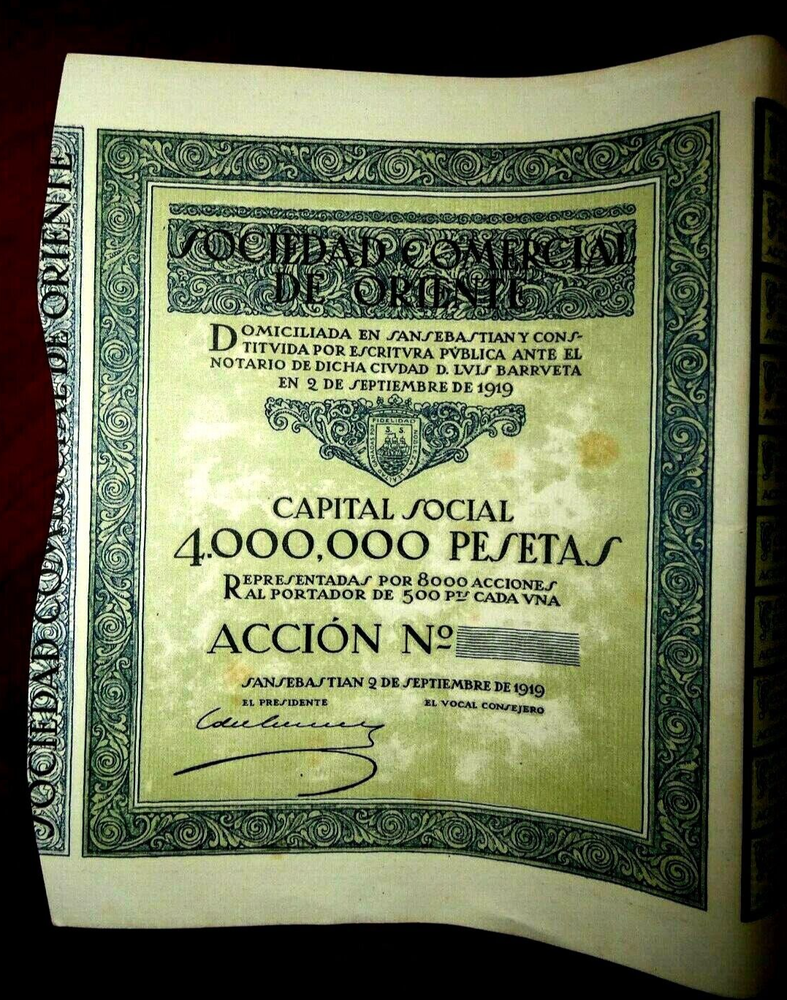
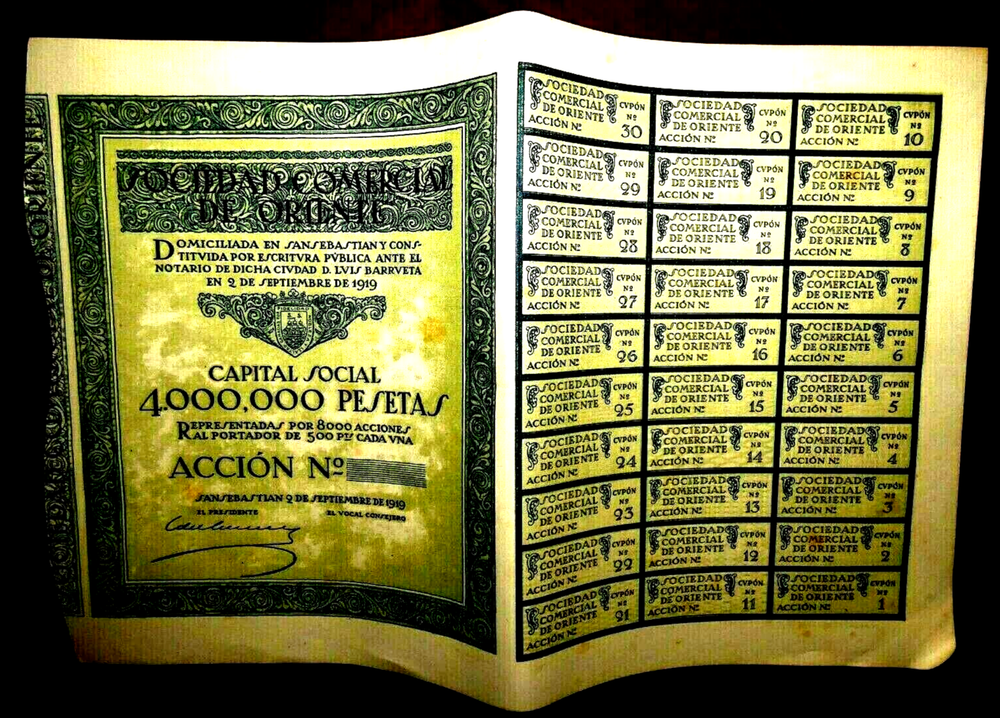
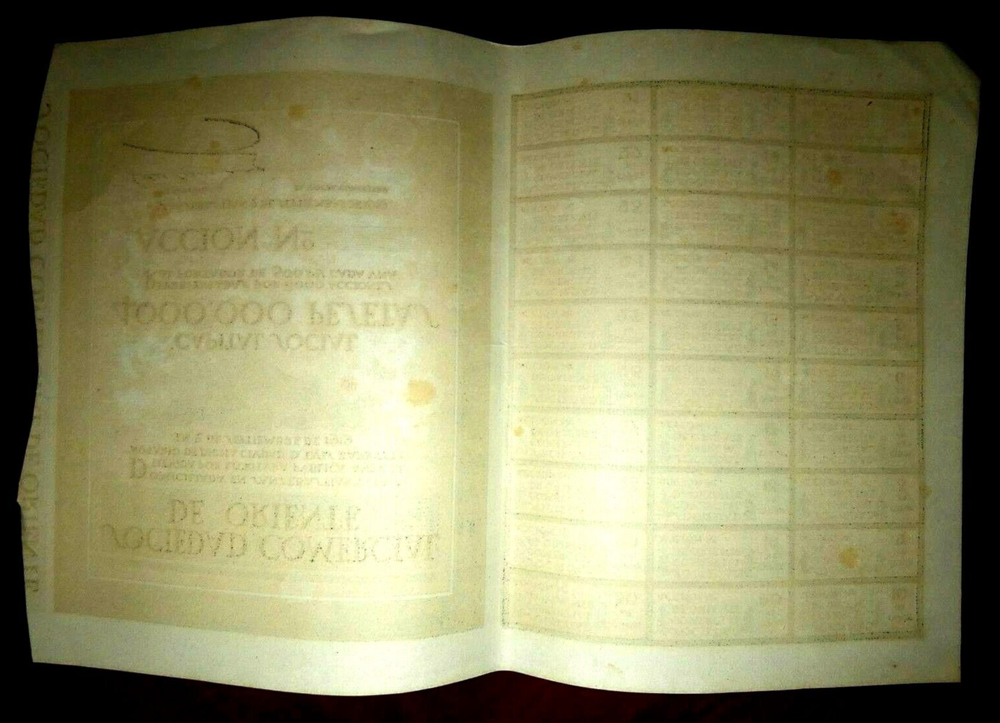
Sociedad Comercial de Oriente SA,Share certificate 1919, Shipping Company Spain
$ 30.1
Description
One bearer share certificate of one ordinary 500 pesetas share of the " SOCIEDAD COMERCIAL DE ORIENTE,S.A. San Sebastian ,Spain 1919 . Condition (opinion) :Fine(F). UNISSUED and UNNUMBERED, with one president print signature.All 30 dividend coupons remain uncut.Shipping company. See below for related information from the web. ---------------------------------------------------------------------------------------- Old share certificate for collection, historical research, with scripophilic,historical or collectable value only. Use this picture for reference only, serial number may be different. Please read carefully the sale terms ,shipping conditions and information below. The buyer accepts those terms, conditions and cost described. --------------------------------------------------------------------------------- Terms of sale and shippig information Postage, including packing material, handling fees : Europe: USD 9.70 / USA $ 10.70. Rest of the World: USD 12.00. FREE of postage for other items. (excluding purchases under US$70.00 with a weight greater than 100 gr. including the protection and packaging card ) . Only one shipping charge per shipment (the highest one) no matter how many items you buy (combined shipping). ----------------------------------------------------------------------------- Guaranteed genuine - One month return policy (retail sales) . Returns accepted with no questions. Customers are invited to combine purchases to save postage. As we have (or could have) more than one identical item ,the serial number may differ from those shown in the picture which is for reference only. For purchases above $70.00 we send the orders registered with tracking number without extra charge, for purchases below $70.00 we ship as regular letters at the buyer's risk. For purchases below $ 70,00 who want to register your letter with tracking number, please add an extra for : Europe $4.20 , U.S. $5.00 ,Rest of the word $5.90 .For this case ,please request or wait for our invoice before paying. Postage include packaging material and handling fees. For some destinations and purchases below $70.00 customers may be requested for this extra shipping payment in order to register the shipment with tracking number. We reserve the right to cancel transactions that require the sending of unregistered letters (without tracking number) to some destinations when this extra payment has been requested. For purchases over $70.00, the excess weight will be free. For purchases under US$70.00 with a weight greater than 100 gr. including the protection and packaging card, the buyer is asked not to make the payment until receiving the invoice or shipment note, since the cost will be calculated and the type of shipment will be assessed (registered or insured or not) and the buyer will be charged the approximate total of the costs of the Post Office rate (rates that are public and can be consulted), in this case the costs of packaging materials, handling and delivery management are free. In the event that the buyer has already made the payment, he will be asked to pay the difference that is missing for the payment of the postal rate. Likewise, we reserve the right to cancel transactions that have not been paid this extra amount when requested. If for any reason, your item did not arrive yet, or you are not 100% satisfied with the item you have received, please do not hesitate to contact , I will do all it takes to provide the best service. Full refund policy ,including shipping cost, guaranteed in case of lost or theft after the completion of the complaint with Spanish Correos for the registered letters (free of extra charges for purchases abobe $70.00 or with the extra charge paid for purchases below $70.00). The buyer must notify to us of the delay in the arrival of his purchase when he meets 3 weeks ( to Europe) to 4 weeks (rest of the World) this guarantee expires two months after the shipment of his purchase if we have not previously received notice of the delay . ----------------------------------------------------------------------------------- Banknote Grading UNC AU EF VF F VG G Fair Poor Uncirculated About Uncirculated Extremely Fine Very Fine Fine Very Good Good Fair Poor Edges no counting marks light counting folds OR... light counting folds corners are not fully rounded much handling on edges rounded edges Folds no folds ...OR one light fold through center max. three light folds or one strong crease several horizontal and vertical folds many folds and creases Paper color paper is clean with bright colors paper may have minimal dirt or some color smudging, but still crisp paper is not excessively dirty, but may have some softness paper may be dirty, discolored or stained very dirty, discolored and with some writing very dirty, discolorated, with writing and some obscured portions very dirty, discolored, with writing and obscured portions Tears no tears no tears into the border minor tears in the border, but out of design tears into the design Holes no holes no center hole, but staple hole usual center hole and staple hole Integrity no pieces missing no large pieces missing piece missing piece missing or tape holding pieces together See below some information related from the web in Spanish and English (translated online): La Sociedad Comercial de Oriente, participada mayoritariamente por la Compañía General de Tabacos de Filipinas, contrató a principios de los años veinte la construcción de dos buques-tanque con el astillero británico Swan, Hunter and Wigham Richardson, Ltd., en Walker-on-Tyne. El destino inicial de ambos buques, llamados CONDE DE CHURRUCA y ARNÚS, era transportar aceite de coco desde Filipinas a España, una de los áreas de negocio de la citada entidad fundada en 1918 en San Sebastián. El ARNÚS fue un buque novedoso en su tiempo ya que se convirtió en el primero de su tipo en España equipado con un sistema propulsor dotado de motor diesel. Una completa descripción del buque se encuentra en el artículo de Vida Marítima titulado “The new motor tanker Arnús…”. En el mes de abril de 1928 la motonave ARNÚS fue vendida a la Compañía Arrendataria del Monopolio de Petróleos, S. A. (CAMPSA), por culpa de la crisis que afectó en la década de los años veinte al mercado naviero que obligó a liquidar la Sociedad Comercial de Oriente en 1927. Sus nuevos propietarios le renombraron BADALONA. En los siguientes años la flota de la naviera pública fue creciendo de forma muy importante gracias a varios contratos adjudicados a diferentes astilleros españoles, alcanzando en julio de 1936 la cifra de 19 unidades, entre buques de altura, gabarras y pontones. Al comienzo de la Guerra Civil española solo dos petroleros BADALONA y CAMPÁS, más los pontones TIFLIS, EBROS y TEXACO, se encontraban en el área controlada por el Gobierno de Burgos. El abastecimiento de combustibles en la zona nacional pudo conseguirse gracias al esfuerzo continuo de estos barcos, en muchos casos navegando por zonas muy peligrosas y necesitando incluso escolta de los buques de la Marina de Guerra. Concretamente al BADALONA le sorprendió el inicio de hostilidades navegando desde Santa Cruz de Tenerife a La Coruña, a donde llegó sin novedad incorporándose como buque militarizado a la Flota nacional. Durante todo el conflicto realizó un importantísimo trabajo como buque nodriza suministrando combustible a las diferentes embarcaciones de la Marina de Guerra nacional, y muy especialmente a los cruceros. En algunos de sus viajes entre la Península y puertos Canarios -------------------------------------------------------------------------------------------------------- La Sociedad Comercial de Oriente, majority owned by the Tobacco Company of the Philippines, hired in the early twenties to build two tankers with the British shipyard Swan Hunter and Wigham Richardson, Ltd., in Walker-on- Tyne. The original purpose of the two vessels, called COUNT OF CHURRUCA and Arnus, coconut oil was transported from the Philippines to Spain, one of the areas of business of that entity founded in 1918 in San Sebastian. The Arnus was a new ship in its time as it became the first of its kind in Spain, equipped with a diesel engine fitted. A complete description of the vessel is in the Marine Life article entitled "The new engine tanker Arnús ...." In April 1928 the MV Arnus was sold to the leasing company's monopoly Petroleos, S. A. (CAMPSA), because of the crisis that hit in the decade of the twenties to the shipping market that forced the liquidation of the Commercial Society of the East in 1927. Her new owners renamed it BADALONA. In the following years the public shipping fleet has grown very significantly due to several contracts awarded to different Spanish shipyards, in July 1936 reaching the figure of 19 units, including tall ships, barges and pontoons. ----------------------- The tireless naval researcher and populariser Vicente Sanahuja Albiñana, author of the successful blog vidamaritima.com, presents his latest publication entitled “The tankers and the Sociedad Comercial de Oriente”. In addition to a first-class documentary and photographic collection, it includes the contribution of the watercolours of Roberto Hernández, the Ship Illustrator, which provides a notable plus of quality, as is evident from the cover, which corresponds to the oil tanker “Conde de Churruca” and the finish on the back cover, which is that of the oil tanker “Arnús”. Throughout 256 pages, in landscape format, Vicente Sanahuja navigates through the history of the first Spanish oil tankers, which are those prior to the creation of CAMPSA and delves in a special way into one of the companies that was a protagonist of this initial stage of oil transport in Spain: the Sociedad Comercial de Oriente. However, the author pays attention to Desmarais, Fourcade and Gurtubay, Catasús and Co., Destilación Babe and Mercader and Londaiz. Then he delves into the Sociedad Comercial de Oriente, established in September 1919 in San Sebastián, of which 70% of its shares belonged to the Compañía General de Tabacos de Filipinas, one of the companies of the Marquis of Comillas, owner of the oil tankers “Conde de Churruca”, “Elcano” and “Arnús”. As is characteristic, Vicente Sanahuja exudes dedication, knowledge, criteria and a guiding thread. Interest down to the smallest detail, which repeatedly surprises us throughout the reading of his new book. A notable contribution that has the collaboration of the Museu Maritim de Barcelona (MMB), Arxiu Nacional de Catalunya, Museo El Dique and Exolum. Prologue by Manuel Rodríguez Aguilar, another of the country's prominent naval researchers, model by Mónica Calvo Artigas, edition by Ignasi Sanahuja Piera and ISBN 978-84-09-43445-9 ----------------------- El incansable investigador y divulgador naval Vicente Sanahuja Albiñana, autor del exitoso blog vidamaritima.com, nos presenta su última publicación titulada “Los buques tanque y la Sociedad Comercial de Oriente”. Además de un fondo documental y fotográfico de primer nivel, incluye el aporte de las acuarelas de Roberto Hernández, el Ilustrador de Barcos, lo que aporta un notorio plus de calidad, como así se pone de manifiesto desde la portada, que corresponde al petrolero “Conde de Churruca” y el remate de la contraportada, que es la del petrolero “Arnús”. A lo largo de 256 páginas, en formato apaisado, Vicente Sanahuja navega en la historia de los primeros buques petroleros españoles, que son aquellos anteriores a la creación de CAMPSA y profundiza de manera especial en una de las compañías protagonistas de esta etapa inicial del transporte de petróleo en España: la Sociedad Comercial de Oriente. No obstante, el autor presta atención a Desmarais, Fourcade y Gurtubay, Catasús y Cía., Destilación Babe y Mercader y Londaiz. Luego se mete de lleno en la Sociedad Comercial de Oriente, constituida en septiembre de 1919 en San Sebastián, de la que el 70% de sus acciones pertenecían a la Compañía General de Tabacos de Filipinas, una de las empresas del marqués de Comillas, armadora de los buques petroleros “Conde de Churruca”, “Elcano” y “Arnús”. Como es característico, Vicente Sanahuja derrocha dedicación, conocimiento, criterio e hilo conductor. Interés hasta el mínimo detalle, lo que nos sorprende reiteradamente a lo largo de la lectura de su nuevo libro. Una notable aportación que tiene la colaboración del Museu Maritim de Barcelona (MMB), Arxiu Nacional de Catalunya, Museo El Dique y Exolum. Prólogo de Manuel Rodríguez Aguilar, otro de los destacados investigadores navales del país, maqueta de Mónica Calvo Artigas, edición de Ignasi Sanahuja Piera e ISBN 978-84-09-43445-9.