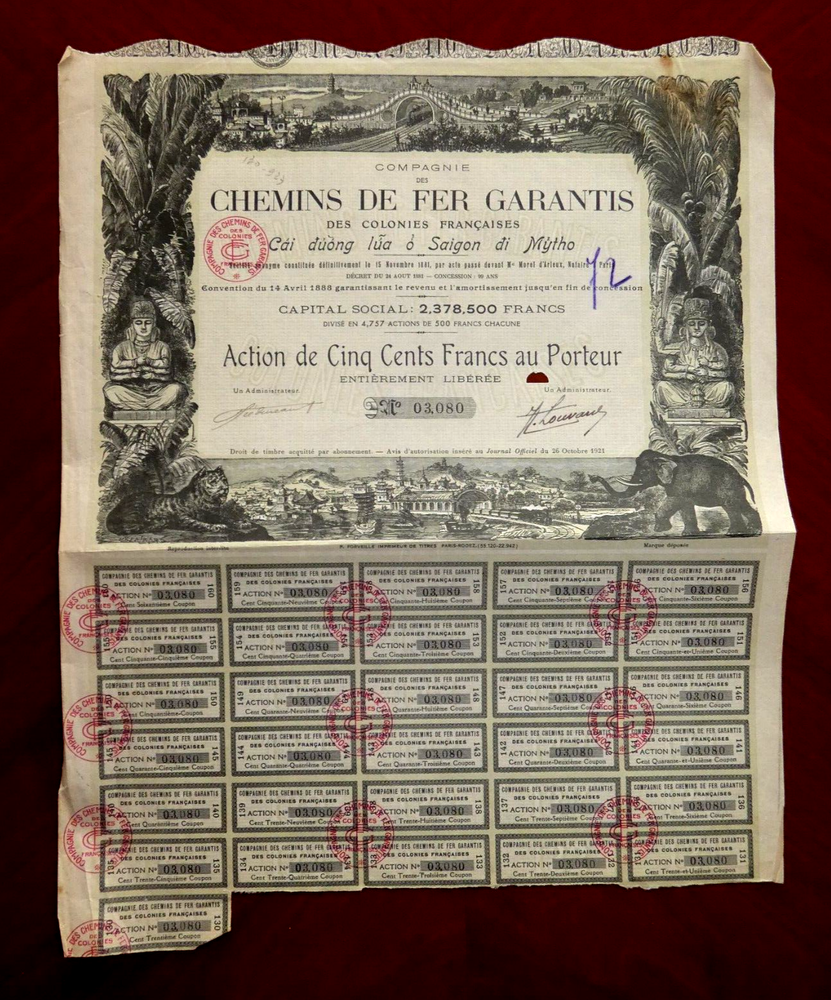
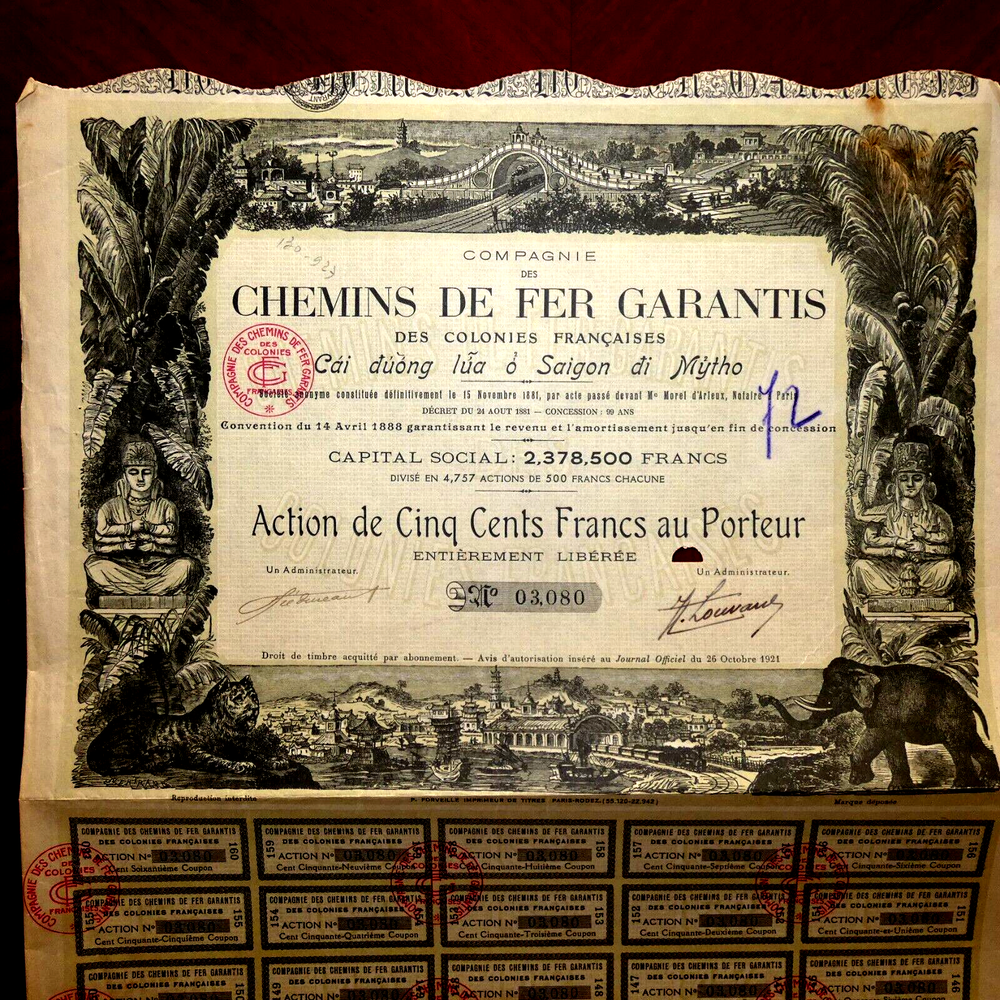
1921 French Colonies Guaranteed Railways 500 Fr Share Certificate
$ 22.71
Description
Notascript Banknotes Bonds & Shares.One bearer share certificate 500 Francs" of "Compagnie des Chemins de Fer Garantis des Colonies Françaises" 1921 Paris (France ) . Condition (opinion) :Very Good (VG), pen writing at right .Printer :P.Forveille imprimeur de titres ,Paris-Rodez. One cancellation hole at the right signature.Two handwritten signatures.Size: 30,7cm/23cm (regular, size without coupons.Contains coupons.Extremely decorative .(See more information below found on the web ,translated online).Watermark paper at left margin.Established 1884. ---------------------------------------------------------------------------------------- This is an old share for collection, historical research, with scripophilic,historical or collectable value only. Use this picture for reference only, serial number may be different. Please read carefully the sale terms ,shipping conditions and information below. The buyer accepts those terms, conditions and cost described. --------------------------------------------------------------------------------- Terms of sale and shippig information Postage, including packing material, handling fees : Europe: USD 9.70 / USA $ 10.70. Rest of the World: USD 12.00. FREE of postage for other items. (excluding purchases under US$70.00 with a weight greater than 100 gr. including the protection and packaging card ) . Only one shipping charge per shipment (the highest one) no matter how many items you buy (combined shipping). ----------------------------------------------------------------------------- Guaranteed genuine - One month return policy (retail sales) . Returns accepted with no questions. Customers are invited to combine purchases to save postage. As we have (or could have) more than one identical item ,the serial number may differ from those shown in the picture which is for reference only. For purchases above $70.00 we send the orders registered with tracking number without extra charge, for purchases below $70.00 we ship as regular letters at the buyer's risk. For purchases below $ 70,00 who want to register your letter with tracking number, please add an extra for : Europe $4.20 , U.S. $5.00 ,Rest of the word $5.90 .For this case ,please request or wait for our invoice before paying. Postage include packaging material and handling fees. For some destinations and purchases below $70.00 customers may be requested for this extra shipping payment in order to register the shipment with tracking number. We reserve the right to cancel transactions that require the sending of unregistered letters (without tracking number) to some destinations when this extra payment has been requested. For purchases over $70.00, the excess weight will be free. For purchases under US$70.00 with a weight greater than 100 gr. including the protection and packaging card, the buyer is asked not to make the payment until receiving the invoice or shipment note, since the cost will be calculated and the type of shipment will be assessed (registered or insured or not) and the buyer will be charged the approximate total of the costs of the Post Office rate (rates that are public and can be consulted), in this case the costs of packaging materials, handling and delivery management are free. In the event that the buyer has already made the payment, he will be asked to pay the difference that is missing for the payment of the postal rate. Likewise, we reserve the right to cancel transactions that have not been paid this extra amount when requested. If for any reason, your item did not arrive yet, or you are not 100% satisfied with the item you have received, please do not hesitate to contact , I will do all it takes to provide the best service. Full refund policy ,including shipping cost, guaranteed in case of lost or theft after the completion of the complaint with Spanish Correos for the registered letters (free of extra charges for purchases abobe $70.00 or with the extra charge paid for purchases below $70.00). The buyer must notify to us of the delay in the arrival of his purchase when he meets 3 weeks ( to Europe) to 4 weeks (rest of the World) this guarantee expires two months after the shipment of his purchase if we have not previously received notice of the delay . ---------------------------------------------------------------------------------------------------------------- Banknote Grading UNC AU EF VF F VG G Fair Poor Uncirculated About Uncirculated Extremely Fine Very Fine Fine Very Good Good Fair Poor Edges no counting marks light counting folds OR... light counting folds corners are not fully rounded much handling on edges rounded edges Folds no folds ...OR one light fold through center max. three light folds or one strong crease several horizontal and vertical folds many folds and creases Paper color paper is clean with bright colors paper may have minimal dirt or some color smudging, but still crisp paper is not excessively dirty, but may have some softness paper may be dirty, discolored or stained very dirty, discolored and with some writing very dirty, discolorated, with writing and some obscured portions very dirty, discolored, with writing and obscured portions Tears no tears no tears into the border minor tears in the border, but out of design tears into the design Holes no holes no center hole, but staple hole usual center hole and staple hole Integrity no pieces missing no large pieces missing piece missing piece missing or tape holding pieces together ------------------------------------- See below related information found on the web (online translated) 1885. Vietnam : Inauguration of the line from Saigon to Mytho Escuchar Leer fonéticamente Diccionario nombre bottler bottling machine French Cochin China was officially opened after ratification of a treaty with the court of Annam in 1862 and many settlers, mostly from Bordeaux, are beginning to settle there. One thinks quickly to the development of the new colony, and in particular the establishment of a network of railways. The issue mobilizes the talents of many officials of the colony. In 1874, the chief engineer of the Public Works Department of the Cochin Eyraud Vergnes suggests the creation of a railway from Saigon to Phnom Penh via Tayning and Preveng. Le Myre de Villers, the first civil governor of Cochin China, is again the studies on the subject. A request for a concession of all was made by J. Rueff, representing the Company's railway in eastern Algeria (EA). The issue is finally debated in 1880. Thevenet The engineer produces a summary of proposed projects, abandoning the northern route, and advocates a path to the south and west, via My Tho and Vinh Long, with any branch of Traon. The administration retains the layout and reduced to the planning of a railway from Saigon to Mytho. A 220 T station in 1905 Mytho Looking for a dealer [edit] It is believed at first to concede the line to a private contractor for a period of 99 years. But the Department of the Navy, who presided over the destinies of the colony, remains cautious. He decides to reduce the construction of the line-only section Saigon Mytho, and submit to the entire project prior to colonial council. So the question is put on the agenda of the first session of the Board, which begins October 11, 1880, but is not debated before November 22. The debates are passionnés1. Councillor Blancsube has a rather extensive project: "As proposed by the administration, the railway must be conceded in principle to Laos. The proposal satisfies me, yet I would see insert this clause in the specifications, the dealer will be required to continue the railway to Yunnan and Tonkin will receive when the order ". Other advisers are more cautious. Paul Blanchy request a railway to Mytho only proposal that was accepted by nine votes against five. Yet nine advisors have ruled for a further extension to Vinh Long. The Governor of Cochinchina early entry into contact with a Joret engineer in Paris. An agreement is established and approved by Presidential Decree of April 24, 1881. Joret created shortly after the railway company secured the French colonies, which does not suit everyone, and especially the leaders of the General Society of steam tramways of Cochinchina (SGTVC): "The line trams and the railway from Saigon to Mytho duplication of Saigon in Cholon. Traffic is absolutely insufficient to support two lines "2. This does not worry unduly Joret, which controls all the hardware in 1882 and fixed most of the rolling stock required to operate the line. "Right now, without a marine disaster that engulfed 1,200 tons of rails, switches and crossings, and 40 cars, all equipment would be made on the spot" 3. At the end of September, Joret announces to its shareholders that the line is completed over four-fifths of the course and is ready to ensure their exploitation. On October 5, 1884, the company has three locomotives in Indochina, four first-class cars or cut, ten second-class cars to brake with postal4 compartment. Late 1884, Joret request the opening of a first leg but turned down the administration. This is the origin of a long controversy between the colony and his dealer. The first clashes between the company and the colony [edit] Some work at the expense of the colony are completed very late, prompting numerous complaints from Joret "Never the colony has operated in our hands correct delivery of the platform of the railway under the Article 2 of the specifications ... to date the settlement has not yet completed the infrastructure work she had to give us, as a result of accidents at the bridge spans unfounded Ben Luc significantly impeding our work "5. The controversy bounces when the Governor refuses Thomson opening the section of 35 km from Ben Luc and Tanana requested December 15, 1884, claiming he did not see the need. Joret above argument holds, and inundates the Office of the Secretary of the Navy of letters vengeful. Thomson quickly explained the Governor: "The work of these two sections are not completed. Indeed, the ramp Binh Dien Bridge, near My Tho, is completed. 10 000 sleepers do not meet the prescribed requirements and must be replaced. The small bridge decking is not done. A number of buildings to be assigned to the service operations are not built, and should be replaced with temporary huts. A number of others are not completed. The level crossing barriers are not all set up, etc ... "6. However, in a letter dated March 21, 1885, Joret argues that "The line was fully completed and acceptable" in the preceding December 15. There is a flagrant denial of this claim in numerous reports to the Governor or in the conduct of public works: "The work of ballasting the part between Luke and Ben will continue Tanan" (February 18, 1885). "The water intake Dinh Chang is not over." "Many are rotten ties, especially in the 10,000 provisional." "All the deviations are in poor condition." "The level crossings are dangerous and almost impassable." It remains to put a needle into the station Mytho. The operation for entering the delivery is done by machines "asking the way to the clip" (March 9, 1885). "The track is in worse condition than during the previous fortnight." 7 Better yet, an employee of Public Works, deploring the fact that there is no signal over the whole of the line, April 16, 1885 note: "Nothing to report except that as in the other Part no curve has been drawn, all were made to found "8. The inauguration of the line and the forfeiture of the concession [edit] The inauguration of Saigon - My Tho takes place July 20, 1885. Deficiencies in the design of the bridge of Ben Luc was not resolved in time, a transfer by ferry is still needed to cross the Vaico rach. Success was quick. On August 10, 1885, Brigadier General Begin the governor may announce that "the Annamite become familiar with this mode of transport, as has occurred for the tram to Saigon Cholon, the success is beyond doubt." In May 1886, Ben Luc hiatus is finally closed and the trains run without change of aircraft from Saigon to Mytho. But the service operation, 7 rue d'Adran installed in Saigon, were quick to raise many derogatory comments, like the line itself: "Mutilated, suspended in a vacuum so to speak, the line Saigon - Mytho was not a real railroad but a sophisticated light rail, a toy offered to the curiosity of indigenous peoples "9. We do not blame the service of exploitation poor maintenance of equipment but a complete lack of maintenance. Bridges, some established provisionally are constructed of wood and give many signs of weakness. "The bridges, particularly those of Vaico and rach Bin Dien and ramps, including the development works presented great difficulties, have led to significant mistakes. They have suffered since their completion of movement showing that they have not yet acquired a definitive stability. "10 The way, asked a hurry, has a tendency to warp causing a few derailments, fortunately not serious. Some crossings have neither barriers nor against rails. Gradually, relations between the company and the administration get worse: "The commuter service that we intend to establish between Saigon and Phu Lam has not been authorized by the colonial government, which fears the company claims the steam tramway in Cholon Saigon '11. Dissatisfied with the dealer, the administration says, April 14, 1888, an additional act to the Convention of August 18, 1881 providing for the surrender of the line to the colony. The reply is not expected. On 17 August the Chief Operating Smith, agent of the company in Cochin, notify the authorities of its intention to cease operation on October 1, 188,812. In mid-September, negotiations between the Department of the Navy and the company give hope for continued operation until 1 January 1889. But Smith turned a deaf ear, lays off staff (immediately repatriated to France) and despite repeated injunctions by the governor, persists in its intention to stop operating on October 1, "even if the company replaces the junior staff ". The seizure of the line [edit] It seems that the authorities have not relied too much on the good faith of the dealer. June 5, the Minister of the Navy announced that it has before "proposals for the operation of Saigon - Mytho. There is a need for an award. " Several applications are in fact made to that effect from a certain engineer Moreny, Draguignan, but also a capitalist Paris, Cardozo. These candidates do not seem to offer sufficient guarantees, and we are moving rapidly toward a decision in-house line. On August 8, 1888, the Minister asked the local government if it is able to replace the railway company for all services operating on the line. He questions the validity of the solution originally planned, which will give a new company and use the pull of the line, while track maintenance and buildings would remain the responsibility of the colony " This combination does entail no conflicts and new challenges? The economy is expected in the transformation of the operating system it is not fictitious? ". The Minister is particularly concerned that it caused by a defective rail replacement and building maintenance. In Cochin, the governor is concerned and do not think being able to operate the line on time. "We only have a few more days to take action if the public works department should be responsible for temporarily operating the railway." La Cochinchine française voit officiellement le jour après ratification d'un traité avec la cour d'Annam en 1862 et de nombreux colons, en majorité bordelais, commencent à s'y installer. On songe rapidement à la mise en valeur de la nouvelle colonie, et en particulier à l'établissement d'un réseau de chemins de fer. La question mobilise les talents des nombreux fonctionnaires de la colonie. Dès 1874, l'ingénieur en chef du service des travaux publics de Cochinchine Eyraud de Vergnes suggère la création d'un chemin de fer de Saïgon à Phnom Penh via Mytho et Vinh Long, avec embranchement éventuel sur Saïgon à Mytho. Une 220 T en gare de Mytho en 1905 À la recherche d'un concessionnaire[ On pense dans un premier temps concéder la ligne à un entrepreneur privé pour une durée de 99 ans. Mais le ministère de la marine, qui préside alors aux destinées de la colonie, reste prudent. Il décide de réduire la construction de la ligne au seul tronçon Saïgon-Mytho, et de soumettre au préalable l'ensemble du projet au conseil colonial. La question est donc inscrite à l'ordre du jour de la première session du conseil, qui débute le 11 octobre 1880, mais n'est pas débattue avant le 22 novembre. Les débats sont passionnés[1]. Le conseiller Blancsube a une conception plutôt extensive du projet : « Tel qu'il est proposé par l'administration, le chemin de fer doit être en principe concédé jusqu'au Laos. Cette proposition me satisfait, mais néanmoins je voudrais voir insérer cette clause dans le cahier des charges, que le concessionnaire sera tenu de continuer le chemin de fer jusqu'au Tonkin et au Yunnan lorsqu'il en recevra l'ordre ». Les autres conseillers sont beaucoup plus prudents. Paul Blanchy demande un chemin de fer jusqu'à Mytho seulement, proposition qui est acceptée par neuf voix contre cinq. Pourtant, neuf conseillers se prononcent également pour un prolongement ultérieur jusqu'à Vinh Long. Le gouverneur de la Cochinchine entre rapidement en contact avec un certain Joret, ingénieur à Paris. Une convention est établie, et approuvée par décret présidentiel du 24 avril 1881. Joret crée peu après la Compagnie des chemins de fer garantis des colonies françaises, ce qui ne fait pas l'affaire de tout le monde, et en particulier des dirigeants de la Société générale des tramways à vapeur de Cochinchine (SGTVC) : « La ligne des tramways et celle des chemins de fer de Saïgon à Mytho font double emploi de Saïgon à Cholon. Le trafic est absolument insuffisant pour faire vivre deux lignes »[2]. Cela n'inquiète pas outre mesure Joret, qui commande dès 1882 tout le matériel fixe et la plus grande partie du matériel roulant nécessaire au fonctionnement de la ligne. « Actuellement, sans un sinistre maritime qui a englouti 1200 tonnes de rails, des appareils de voie, et 40 wagons, tout le matériel serait rendu sur place »[3]. À la fin du mois de septembre, Joret annonce à ses actionnaires que la ligne est terminée sur les quatre cinquièmes du parcours et qu'il est prêt à en assurer l'exploitation. Le 5 octobre 1884, la compagnie dispose en Indochine de trois locomotives, de quatre voitures de première classe ou coupés, de dix voitures de deuxième classe à frein avec compartiment postal[4]. Fin 1884, Joret demande l'ouverture d'un premier tronçon mais essuie un refus de l'administration. C'est l'origine d'une longue polémique entre la colonie et son concessionnaire. Les premiers heurts entre la compagnie et la colonie[ Certains travaux à la charge de la colonie sont terminés avec beaucoup de retard, ce qui suscite de nombreuses récriminations de Joret : « Jamais la colonie n'a opéré entre nos mains la remise régulière de la plate-forme du chemin de fer prévue par l'article 2 du cahier des charges ... à ce jour la colonie n'a pas encore terminé les travaux d'infrastructure qu'elle avait à nous livrer, par suite d'accidents survenus à des travées mal fondées du pont de [5]. La polémique rebondit lorsque le gouverneur Thomson refuse l'ouverture du tronçon de 35 kilomètres entre [6]. Pourtant, dans une lettre du 21 mars 1885, Joret soutient que « La ligne était complètement terminée et recevable » au 15 décembre précédent. On trouve un démenti flagrant de cette affirmation dans les nombreux rapports adressés au gouverneur ou à la direction des travaux publics : « Les travaux de ballastage de la partie comprise entre [7]. Mieux encore, un employé des travaux publics, déplorant le fait qu'il n'existe aucun signal sur toute l'étendue de la ligne, note le 16 avril 1885 : « Rien à signaler si ce n'est que comme dans l'autre partie, aucune courbe n'a été tracée; toutes ont été faites au jugé »[8]. L'inauguration de la ligne et la déchéance du concessionnaire[ L'inauguration du Saïgon - Mytho a lieu le 20 juillet 1885. Les carences dans la conception du pont de Saïgon à Cholon, dont le succès est hors de doute ». En mai 1886, le hiatus de [9]. On ne reproche pas au service de l'exploitation un mauvais entretien du matériel mais plutôt une absence totale d'entretien. Les ponts, dont certains établis à titre provisoire, sont construits en bois et donnent de nombreux signes de faiblesse. « Les ponts, notamment ceux du Vaïco et du rach Bin Dien et leurs rampes d'accès, ouvrages dont l'établissement a présenté de grandes difficultés, ont donné lieu à des mécomptes importants. Ils ont subi depuis leur achèvement des mouvements montrant qu'ils n'ont pas encore acquis une stabilité définitive »[10]. La voie, posée à la va-vite, a une fâcheuse tendance à se déformer ce qui provoque quelques déraillements, heureusement sans gravité. Certains passages à niveau ne possèdent ni barrières ni contre-rails. Peu à peu, les relations entre la compagnie et l'administration s'aggravent : « Le service de banlieue que nous comptions établir entre Saïgon et [11]. Peu satisfaite du concessionnaire, l'administration ajoute, le 14 avril 1888, un acte additionnel à la convention du 18 août 1881 prévoyant la rétrocession de la ligne à la colonie. La réplique ne se fait pas attendre. Le 17 août, le directeur de l'exploitation Smith, mandataire de la compagnie en Cochinchine, notifie aux autorités son intention de cesser l'exploitation le 1er octobre 1888[12]. À la mi-septembre, les négociations entre le ministère de la marine et la compagnie laissent espérer une poursuite de l'exploitation jusqu'au 1er janvier 1889. Mais Smith fait la sourde-oreille, licencie le personnel (aussitôt rapatrié en France) et malgré les multiples injonctions adressées par le gouverneur, persiste dans son intention d'arrêter l'exploitation au 1er octobre, « même si la compagnie remplace le personnel subalterne ». La mise sous séquestre de la ligne[ Il semble que les autorités n'aient pas trop compté sur la bonne foi du concessionnaire. Le 5 juin, le ministre de la marine annonce qu'il est saisi de « propositions pour l'exploitation du Saïgon - Mytho. Il est nécessaire de prévoir une adjudication ». Plusieurs demandes sont en effet formulées en ce sens, provenant d'un certain ingénieur Moreny, de Draguignan, mais aussi d'un capitaliste parisien, Cochinchine, le gouverneur est inquiet et ne pense pas être en mesure d'exploiter la ligne à la date prévue. « Il ne nous reste plus que quelques jours pour prendre les mesures nécessaires si le service des travaux publics doit être chargé provisoirement de l'exploitation du chemin de fer ». ----------------------------------------------